The Koreen Odiney Story | We're Not Really Strangers
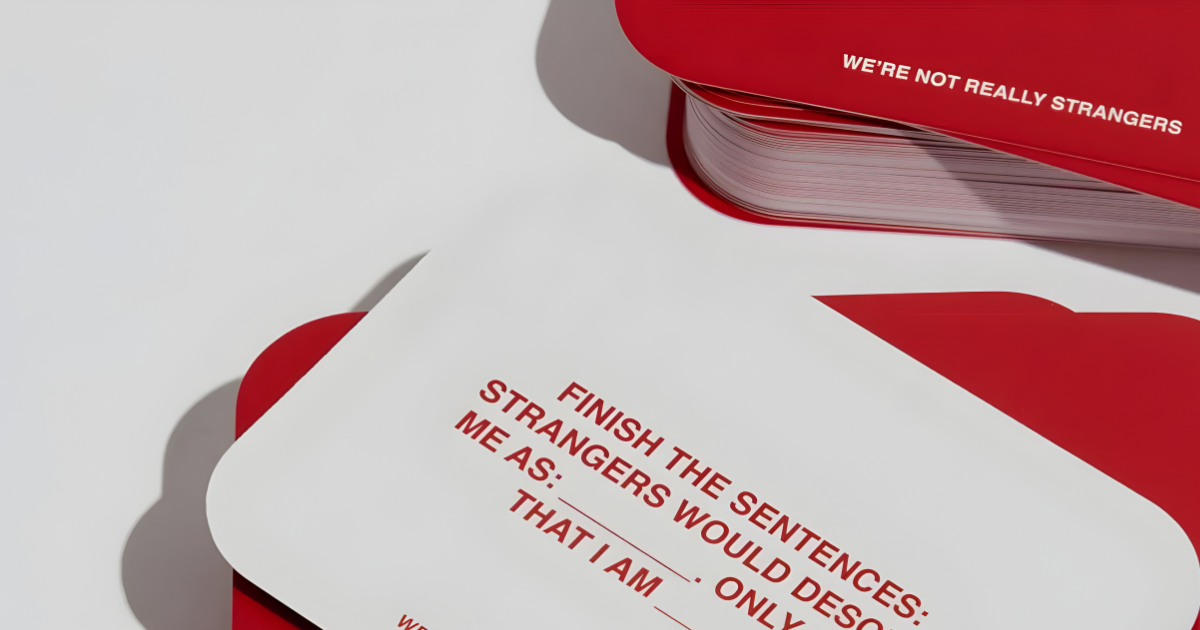
We're Not Really Strangers has become one of the most recognizable brands of the last decade, those red and white cards, those questions that make you go quiet for a second. But most people have no idea where it actually came from. In this episode, we talk about Koreen Odiney, founder, photographer, and the woman who turned a broken heart into a global movement. At 16, after her first heartbreak, Koreen walked out onto Ventura Boulevard in Los Angeles and started asking strangers one question: Did you ever get over your first love? That single act of vulnerability became the seed for everything.
-
Welcome back to Fifteenish. This is Leah. Hey, friends.
As some of you might know, I have a 16-year-old daughter, and if you also have a teenager, or if you remember being one, you know that very real feeling of heartbreak at this age, especially that first real heartbreak, where it feels like suddenly
their world actually ends for a little while. It's deep and painful. I've been watching my daughter go through it recently, and I want to tell you, there is nothing I can say that can make things better. As a parent, I want to fix it so badly.
I just want to reach in and take that pain out of her chest and carry it myself. But I can't. She just has to feel it.
You know, there's this weird thing that happens when you watch your kid go through something hard. You start remembering what it felt like for you. You go back there for a little bit.
And I found myself thinking about being 16 and heartbroken and how enormous that felt.
How I was completely convinced that nobody in the history of the world had ever loved someone the way I loved that person and therefore nobody in the history of the world had ever hurt that much. Do you know that feeling?
Well, I got to thinking, what do we actually do with that pain when we're in it? Because most of us turn inward, right?
We cry to our best friends, we journal, we listen to sad songs and repeat, and somehow it makes it worse and better at the same time. Or sometimes we sit in our rooms and we feel it and we wait for it to pass.
1:39
Koreenʼs Question
But today, I want to talk to you about a girl who did something I have genuinely never heard of anyone this age doing.
She was 16, she was heartbroken, and instead of turning inward, she picked up her camera, walked outside, and started asking strangers on the street one single question. Did you ever get over your first love?
That girl was Koreen Odiney, and that one question asked on the sidewalk in LA when she was just 16 years old, is where We're Not Really Strangers began. Now, I'm sure you've seen those little red and white cards somewhere.
Maybe you've seen them on Instagram or on someone's coffee table, or maybe you've even played the game. But I want to tell you where it actually came from, because the origin of this thing is so much more expansive than you'd expect.
So let's talk about it. Koreen grew up in Los Angeles. She moved there from Israel with her mom when she was just five years old.
And from a really young age, she was obsessed with photography. She had a camera around her neck constantly, always looking for the right angle, the right light, the right moment. She loved capturing people.
She was drawn to faces and all of their expressions. She had this instinct even as a kid that a photo could get to something that words couldn't reach. And then she turned 16 and she got her heart broken for the first time.
Now, I want you to really sit with this moment for a second. In hindsight, we talk about first heartbreaks like, oh, they're so cute. Like they're just a rite of passage.
Maybe it's a little bump in the road, but they're not, are they? When you're in it, it is devastating. It is the most real pain that you've ever felt in your life up to that point.
And the worst part is nobody around you quite understands the size of it. The adults in your life are like, oh, sweetie, you'll be fine. There's other fish in the sea.
And maybe they're right, but that doesn't help at all when you're 16 and your heart is actually broken. And most of us in that moment, like I said, we turn inward. We go hide in our rooms.
But Koreen, she went outside. She picked up her camera, the thing that had always been her way of connecting with people, and she walked out into the streets of LA, and she started stopping strangers just to ask them one thing.
Did you ever get over your first love? She said she was seeking perspective. She needed to know that it was survivable.
She needed someone to tell her the truth. She didn't want the pep talk that adults tell you to make you feel better. She wanted the actual truth, the complicated and often messy real version.
4:10
Healing Through Connection
I love what happened next for her. They actually answered her, complete strangers stopped in the sidewalk and they looked at this teenage girl with the camera and they just opened up.
They told her about loves that they still thought about 30 years later, about the ones that got away and the little bit of grief that they still carry.
They shared with her about the ones that they were so relieved to have lost, even though it didn't feel that way at the time. They said, yes, you do get over it, but sometimes getting over it takes longer than anyone tells you.
They shared about how heartbreak can break you open in ways that are actually kind of a gift if you let them be. And Koreen says that's when she started to heal, because she asked, because she found connection.
She realized that her pain wasn't unique. She realized that every single person she stopped on that street had felt something like it, that she wasn't alone in it. She went out there looking for perspective and that is exactly what she got.
This really hits home for me right now, especially watching my daughter, because I think so often when we're hurting, the instinct is to hide the hurt and protect ourselves.
Maybe for some of us, we don't even want anyone to see how big it actually feels. But Koreen did the exact opposite. She walked straight towards other people with her pain and said, help me understand this.
Tell me the truth. And they did. There is something in that.
I really think there's something in that.
5:37
Camera as Catalyst
And Koreen, well, she kept moving forward and through the rest of high school into her early 20s, while she was building a modeling career, every spare moment she had was out on the streets of LA with her camera, photographing strangers, asking them
questions. While it wasn't just about heartbreak anymore, it was about anything real, about loss and love and regret and what they were most proud of and what they wished they'd said to someone. She said something about this that I love so, so much.
She said she couldn't just walk up to someone on the street and say, hey, tell me the last time you cried. But interestingly, with her camera, she could. The camera was her way in.
It gave her a reason to approach. It gave strangers a reason to let their guard down. It made this whole thing feel like something, a project or an interview, maybe a portrait session.
When really it was just Koreen trying to do the one thing that had helped her at 16. Connect. Ask the real question.
Make someone feel less alone by letting them know they weren't the only one. And every single time, people opened up. It didn't matter who they were, young, old, reserved, chatty, guarded.
When she asked them the right question, they went there every single time. I think that tells us something really important. People are so much more willing to be seen than we give them credit for.
We walk around assuming everyone wants to keep things on surface level, that no one actually wants to go deep, that asking a real question is intrusive or weird. But Koreen proved over and over again that that is just not true.
People are just starving to be asked something real. They just need someone to go first. Friends, did you hear that?
They just need someone to go first.
7:27
A Prophetic Encounter
So in 2014, something happened that kind of locked everything else in. Koreen spotted a man sitting alone on a park bench reading poetry. She walked up to him, camera around her neck, and they got to talking.
It was one of those conversations that just goes longer than you expected, where you look up and realize an hour has passed. Those are my favorite kind. And at the end of it, he said something she wasn't expecting at all.
He told her one day she would write a book called We're Not Really Strangers. She had never heard those words before, but when she did, something clicked into place. I have full on goosebumps from this.
Could you imagine being Koreen in that moment? For someone to speak with such conviction around this idea about her life. I truly love that moment for her.
And what's so cool about that is that was exactly what all of these conversations had been proving over and over again for years. That we aren't really strangers. That the distance between people is so much smaller than we think.
That just one honest question is genuinely all it takes to close that gap. And she thought, well, what if I could give that to other people? What if there was a way to create that feeling on purpose?
Not just for the people lucky enough to cross paths with a girl carrying a camera on a random Tuesday in LA, but for anyone, anywhere. That, my friend, was the spark.
8:53
Four Years of Doubt
But here's the part of Koreen's story that I think is so important and so relatable but so rarely talked about. It took her four years to actually launch the game. Yes, four years.
I think it's really easy to hear that and think, okay, she spent four years developing it. That makes sense. Big projects take time.
But that's not what really four years of sitting on something feels like from the inside. Let me tell you what it actually feels like.
It feels like waking up every day, knowing you have this thing that you believe in, that you know matters, that has already changed your life, and just not being able to make yourself release it into the world.
It feels like getting so close and then pulling back. It feels like tweaking one more question, running one more test, letting one more friend try the prototype, telling yourself it just needs a little more work before it's ready.
And the whole time, people around her were saying, just launch it already, just put it out there, it's good enough. What are you waiting for? She was full of self-doubt.
This wasn't just a product to Koreen. This was the most personal thing she had ever made. It was built from her pain.
It was built from years of the most vulnerable, intimate conversations that she'd ever have with strangers. And what if she put it out there and people didn't get it?
What if the thing that has been so sacred and so healing in her life, just became another card game on a shelf somewhere? That is a terrifying thought, especially when the thing you're releasing is so close to who you are.
And by the way, she funded the whole development through her modeling work. She wasn't waiting on investors or a business partner.
She was just a woman with a dream and a job, pouring her own money into something that she believed in, and was also too scared to let anyone else decide if it was good enough.
But she kept coming back to that original feeling, that 16 year old girl on a sidewalk who just needed one honest answer. She kept asking herself, does this game create that? Does someone else walk away from this feeling less alone?
When she could finally, genuinely say yes, she launched it in 2018. And guys, it didn't just sell, it became a whole movement. Within a couple years, she reached millions of followers.
She had coverage in Forbes and Vogue. She got a partnership with Red Table Talk. She had a full clothing line, expansion packs, and hundreds of hundreds of stories from real people about the conversations that the game made them have.
The convos they'd been avoiding for years. The convos that changed things. One guy even sent her a DM.
He said, one of those cards asked him to share something he'd been holding back. He told the girl he was playing this game with that he was in love with her. And she drove an hour and a half from another state to tell him she felt the same way.
I mean, come on. This is exactly what Kareen built. From one question asked on a sidewalk when she was 16 and heartbroken and just trying to feel less alone.
11:54
Intentional Vulnerability
What I love most about this is that Kareen didn't start with a business in mind. She started with a wound. She built the whole thing from the exact place that she felt most vulnerable.
From the question that she was too embarrassed and too raw to ask anyone that she actually knew. I think that's exactly why it works. That's why We're Not Really Strangers doesn't feel like a product.
It feels like something someone made because they had to, because they needed it to exist. And when something is made from that place, people can feel it. They pick it up and something in them goes, this is real.
Someone made this for me. She also said something once that I keep coming back to. She said, vulnerability should be earned even in a moment, meaning you don't know everyone your whole heart.
Not every conversation needs to go deep. But when someone creates a space that feels safe, go there. Don't talk yourself out of it.
Don't talk yourself out of being real. Gosh, that hit me. Now, I'm not someone who has ever struggled to be vulnerable, like at all.
I have absolutely spilled my entire life on people who probably didn't ask for all of that. People who said, how are you? And genuinely just meant it as a greeting.
Sorry to anyone who experienced that for me. But what Kareen said made me think about it differently. My vulnerability is actually something sacred.
It's not something I should be handing out to everyone who happens to be standing nearby. It should go to people who can actually receive it. People who created the space for it, people who earned it.
That feels like a really different way to move through the world. And I think that's kind of the whole point of Kareen's story. She didn't just build a brand around vulnerability, she built it around intentional vulnerability.
The kind of vulnerability that means something. The kind that actually has impact because someone created the right conditions for it first. And I think that's true in business too.
The things we build that actually resonate, that actually make people feel something. They're almost always the ones that started with a feeling we couldn't explain, but also couldn't let go of.
The businesses that actually connect, the ones that build real communities, real loyalty, real meaning, they almost never start out with a perfect strategy.
They started with something true, something personal, something the founder was almost too scared to share because it felt too close.
Koreen's Whole Company, this brand that millions of people have connected over, that has brought strangers together and rekindled relationships, and helped people say the things that they've been holding off for years.
She built the whole thing from the rawest part of herself, and that is exactly why it worked. So maybe, friend, stop trying to make your thing more digestible, more marketable, more like what everyone else is already doing.
Maybe the version of your business that actually works best is the one that is still a little uncomfortable to talk about. We're Not Really Strangers all started because a 16-year-old girl was brave enough to ask a stranger one real question.
She went outside looking to feel less alone, and she ended up building something that gave millions of people that exact same thing. If that's not a reason to ask the question or to do the thing, I don't know what is.
Thanks for being here, I'll see you next week.
Sources & Disclaimer
This episode was created using publicly available information about Koreen Odiney and We're Not Really Strangers, gathered from verified interviews, articles, and brand coverage, including:
Hypebae — Interview with Koreen Odiney on the origin of WNRS and her photography background (November 2020)
The Digital Campfire — "How a Card Game Exploded into a Global Movement" (September 2020)
ILY Magazine — Interview with Koreen Odiney on heartbreak, vulnerability, and building WNRS (November 2019)
UP Magazine — "Turning Lessons into Art: The Story Behind We're Not Really Strangers" (February 2023)
Wikipedia — We're Not Really Strangers entry
All facts shared in this episode are based on information available at the time of recording. Any personal reflections, interpretations, or opinions included are my own. If any details are found to be inaccurate, I'm happy to issue corrections.